Pollution is defined as ‘an addition or excessive addition of certain materials to the physical environment (water, air and lands), making it less fit or unfit for life’.
POLLUTANTS
Pollutants are the materials or factors, which cause adverse effect on the natural quality of any component of the environment.
For example, smoke from industries and automobiles, chemicals from factories, radioactive substances from nuclear plants, sewage of houses and discarded household articles are the common pollutants.
Classifications
(i) According to the form in which they persist after release into the environment.
• Primary pollutants: These persist in the form in which they are added to the environment e.g. DDT, plastic.
• Secondary Pollutants: These are formed by interaction among the primary pollutants.
• For example, peroxyacetyl nitrate (PAN) is formed by the interaction of nitrogen oxides and hydrocarbons.
(ii) According to their existence in nature.
• Quantitative Pollutants: These occur in nature and become pollutant when their concentration reaches beyond a threshold level. E.g. carbon dioxide, nitrogen oxide.
• Qualitative Pollutants: These do not occur in nature and are man-made. E.g. fungicides, herbicides, DDT etc.
(iii) According to their nature of disposal.
• Biodegradable Pollutants: Waste products, which are degraded by microbial action. E.g. sewage.
• Non-biodegradable Pollutants: Pollutants, which are not decomposed by microbial action. E.g. plastics, glass, DDT, salts of heavy metals, radioactive substances etc.)
(iv) According to origin
• Natural
• Anthropogenic
Causes of pollution
Uncontrolled growth in human population
• Rapid industrialization
• Urbanization
• Uncontrolled exploitation of nature.
• Forest fires, radioactivity, volcanic eruptions, strong winds etc.
1. AIR POLLUTION
Air pollution is aggravated because of four developments: increasing traffic, growing cities, rapid economic development, and industrialization.
• ‘The presence in the atmosphere of one or more contaminants in such quality and for such duration as it is injurious, or tends to be injurious, to human health or welfare, animal or plant life.’
• It is the contamination of air by the discharge of harmful substances.
• Air pollution can cause health problems, damage the environment, property and climate change.
Major air pollutants and their sources Carbon monoxide (CO)
It is a colourless, odourless gas that is produced by the incomplete burning of carbon-based fuels including petrol, diesel, and wood.
• It is also produced from the combustion of natural and synthetic products such as cigarettes.
• It lowers the amount of oxygen that enters our blood.
• It can slow our reflexes and make us confused and sleepy
Carbon dioxide (CO2)
- It is the principle greenhouse gas emitted as a result of human activities such as the burning of coal, oil, and natural gases.
Chlorofluorocarbons (CFC)
These are gases that are released mainly from air-conditioning systems and refrigeration.
• When released into the air, CFCs rise to the stratosphere, where they come in contact with few other gases, which lead to a reduction of the ozone layer that protects the earth from the harmful ultraviolet rays of the sun.
Lead
It is present in petrol, diesel, lead batteries, paints, hair dye products, etc. Lead affects children in particular.
• It can cause nervous system damage and digestive problems and, in some cases, cause cancer.
Ozone
This important gas shields the earth from the harmful ultraviolet rays of the sun.
• However, at the ground level, it is a pollutant with highly toxic effects.
• Vehicles and industries are the major source of ground level ozone emissions.
• Ozone makes our eyes itch, burn, and water. It lowers our resistance to cold and pneumonia. • Nitrogen oxide (Nox)
• It causes smog and acid rain. It is produced from burning fuels including petrol, diesel, and coal. • Nitrogen oxide can make children susceptible to respiratory diseases in winters.
Suspended particulate matter (SPM)
It consists of solids in the air in the form of smoke, dust, and vapour that can remain suspended for extended periods and is also the main source of haze which reduces visibility.
• The finer of these particles, when breathed in can lodge in our lungs and cause lung damage and respiratory problems.
Sulphur dioxide (SO2)
It is a gas produced from burning coal, mainly in thermal power plants.
• Some industrial processes, such as production of paper and smelting of metals, produce sulphur dioxide.
• It is a major contributor to smog and acid rain. Sulfur dioxide can lead to lung diseases.
2. Smog
The term smog was first used in 1905 by Dr H A Des Voeux
• Smog has been coined from a combination of the words fog and smoke. Smog is a condition of fog that had soot or smoke in it.
The Formation of Smog
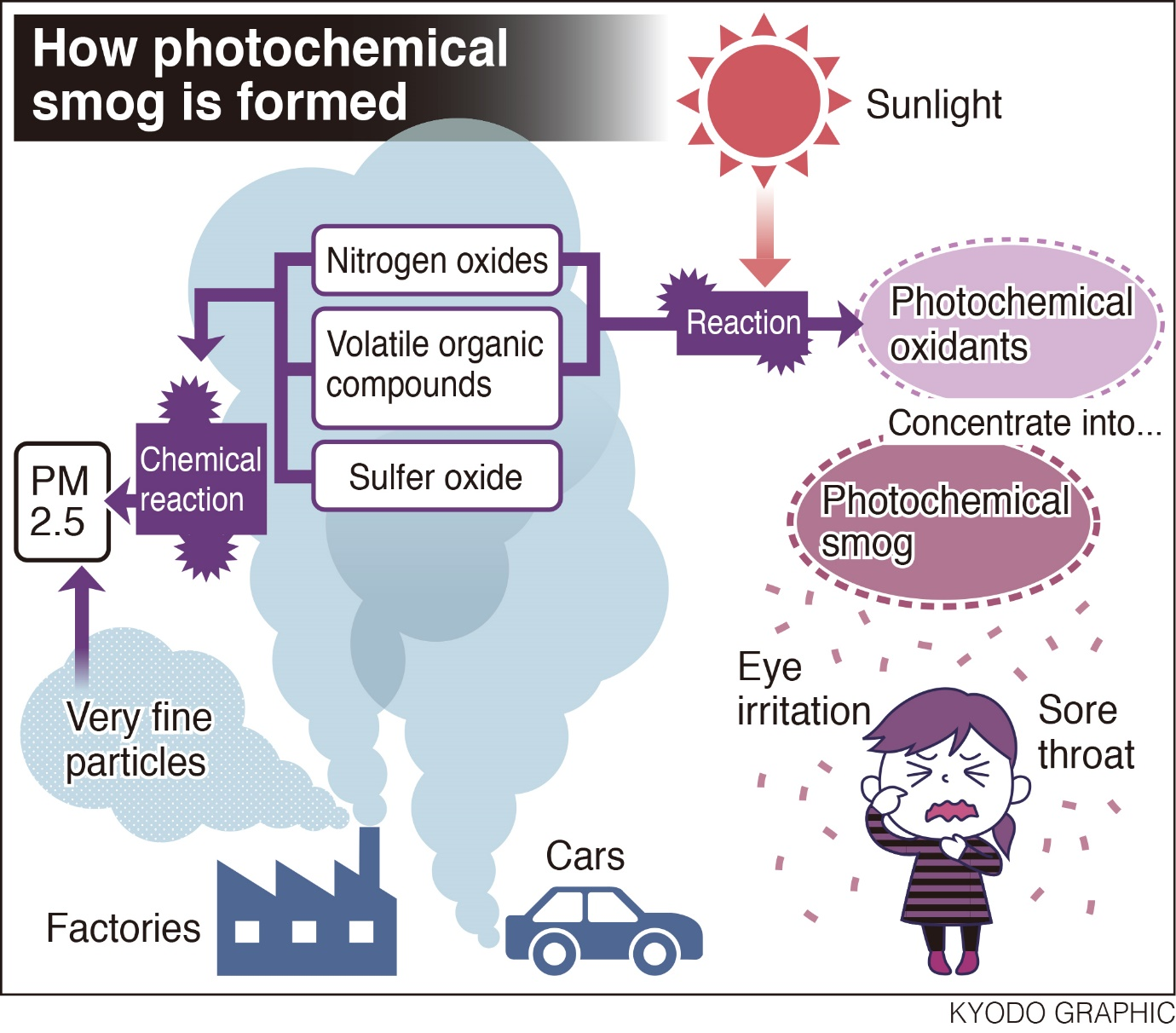
Photochemical smog (smog) is a term used to describe air pollution that is a result of the interaction of sunlight with certain chemicals in the atmosphere.
• One of the primary components of photochemical smog is ozone.
• While ozone in the stratosphere protects earth from harmful UV radiation, ozone on the ground is hazardous to human health.
• Ground-level ozone is formed when vehicle emissions containing nitrogen oxides (primarily from vehicle exhaust) and volatile organic compounds (from paints, solvents, printing inks, petroleum products, vehicles, etc.) interact in the presence of sunlight.

Smog refers to hazy air that causes difficult breathing conditions. It is a combination of various gases with water vapour and dust.
• Its occurrences are often linked to heavy traffic, high temperatures, and calm winds. During the winter, wind speeds are low and cause the smoke and fog to stagnate near the ground; hence pollution levels can increase near ground level.
• Smoke particles trapped in the fog gives it a yellow/ black colour and this smog often settled over cities for many days
• Ground-level ozone is formed through a complex reaction involving hydrocarbons, nitrogen oxides, and sunlight. It is formed when pollutants released from gasoline, diesel powered vehicles and oil-based solvents react with heat and sunlight.
The effects of smog
It hampers visibility and harms the environment.
• Respiratory problems
• Deaths relating to bronchial diseases.
• Heavy smog greatly decreases ultraviolet radiation.
• Heavy smog results in the decrease of natural vitamin D production leading to a rise in the cases of rickets.
3. Indoor air pollution
It refers to the physical, chemical, and biological characteristics of air in the indoor environment within a home, or an institution or commercial facility.
• Indoor air pollution is a concern where energy efficiency improvements sometimes make houses relatively airtight, reducing ventilation and raising pollutant levels.
• Indoor air problems can be subtle and do not always produce easily recognized impacts on health.
• Different conditions are responsible for indoor air pollution in the rural areas and the urban areas.
(a) Rural
• It is the rural areas that face the greatest threat from indoor pollution, where people rely on traditional fuels such as firewood, charcoal, and cow dung for cooking and heating.
• Burning such fuels produces large amount of smoke and other air pollutants in the confined space of the home, resulting in high exposure. Women and children are the groups most vulnerable as they spend more time indoors and are exposed to the smoke.
• Although many hundreds of separate chemical agents have been identified in the smoke from biofuels, the four most serious pollutants are particulates, carbon monoxide, polycyclic organic matter, and formaldehyde.
(b) Urban
• In urban areas, exposure to indoor air pollution has increased due to a variety of reasons, such as • construction of more tightly sealed buildings,
• reduced ventilation,
• the use of synthetic materials for building and furnishing and
• the use of chemical products, pesticides, and household care products.
• Indoor air pollution can begin within the building or drawn in from outdoors.
• Other than nitrogen dioxide, carbon monoxide, and lead, there are a number of other pollutants that affect the air quality.
Pollutants
i) Volatile organic compounds.
• The main indoor sources are perfumes, hair sprays, furniture polish, glues, air fresheners, moth repellents, wood preservatives, and other products.
• Health effect – irritation of the eye, nose and throat, headaches, nausea and loss of coordination.
• Long term – suspected to damage the liver and other parts of the body.
ii) Tobacco
• Smoke generates a wide range of harmful chemicals and is carcinogenic.
• Health effect – burning eyes, nose, and throat irritation to cancer, bronchitis, severe asthma, and a decrease in lung function.
iii) Biological pollutants
• It includes pollen from plants, mite, and hair from pets, fungi, parasites, and some bacteria. Most of them are allergens and can cause asthma, hay fever, and other allergic diseases.
iv) Formaldehyde
• Mainly from carpets, particle boards, and insulation foam. It causes irritation to the eyes and nose and allergies.
v) Radon
• It is a gas that is emitted naturally by the soil. Due to modern houses having poor ventilation, it is confined inside the house and causes lung cancers.
vi) Asbestos
vii) Pesticides
4. Fly Ash
Ash is produced whenever combustion of solid material takes place.
• Fly ash is one such residue which rises with the gases into the atmosphere. Fly ash is a very fine powder and tends to travel far in the air. The ash which does not rise is termed as bottom ash.
• Nearly 73% of India’s total installed power generation capacity is thermal, of which 90% is coal-based generation, with diesel, wind, gas, and steam making up the rest.
Composition
1. Aluminium silicate (in large amounts)
2. Silicon dioxide (SiO2) and
3. Calcium oxide (CaO).
• Fly ash particles are oxide rich and consist of silica, alumina, oxides of iron, calcium, and magnesium and toxic heavy metals like lead, arsenic, cobalt, and copper.
How it is collected?
- Fly ash is generally captured by electrostatic precipitators or other particle filtration equipment’s before the flue gases reach the chimneys of coal-fired power plants.
Environmental effects?
If fly ash is not captured and disposed off properly, it can pollute air and water considerably.
• It causes respiratory problems.
• Fly ash in the air slowly settles on leaves and crops in fields in areas near to thermal power plants and lowers the plant yield.
Advantages:
• Cement can be replaced by fly ash up to 35%, thus reducing the cost of construction, making roads, etc.
• Fly ash bricks are light in weight and offer high strength and durability.
• Fly ash is a better fill material for road embankments and in concrete roads.
• Fly ash can be used in reclamation of wastelands.
• Abandoned mines can be filled up with fly ash.
• Fly ash can increase the crop yield and it also enhances water holding capacity of the land.
Policy measures of MoEF:
• The Ministry of Environment and Forests vide its notification in 2009, has made it mandatory to use Fly Ash based products in all construction projects, road embankment works and low lying land filling works within 100 kms radius of Thermal Power Station.
• To use Fly Ash in mine filling activities within 50 kms radius of Thermal Power Stations.
5. Air Pollution in India
• India’s air pollution, ranked among the worst in the world is adversely impacting the lifespan of its citizens, reducing most Indian lives by over three years – WHO.
• Over half of India’s population – 660 million people – live in areas where fine particulate matter pollution is above India’s standards for what is considered safe – ‘Economic & Political Weekly’
• Of the world’s top 20 polluted cities, 13 are in India. Air pollution slashes life expectancy by 3.2 years for the 660 million Indians who live in cities.
• 2014 global analysis of how nations tackle environmental challenges has ranked India 155 among 177 nations and labelled the country’s air quality among the worst in the world.
• India is placed as the “bottom performer” on several indicators such as environmental health impact, air quality, water and sanitation and India’s environment health severely lags behind the BRICS nations – Environmental Performance Index 2014.
• The Ganga and Yamuna are ranked among the world’s 10 most polluted rivers.
• Despite the directives of the National Green Tribunal, civic agencies continue to allow concretisation in green belts. Booming real estate and demand for housing units is leading to change of land use and shrinkage of natural conservation zones such as forests, water bodies, wastelands, sanctuaries, groundwater rechargeable areas.
• Mindless concretisation of ground and green belts and booming real estate has led to heat island
effect – shortwave radiations emanate from concrete surfaces at night time. Concretisation prevents
ground water recharge thus depleting green cover. Tall buildings also block winds thereby reducing their cooling effect. Excessive concretisation also leads to weakening of trees.
• The environmental crisis in India is many-sided and multi-faceted which has to be addressed on different fronts and by a variety of different actors. We need to harness scientific and social-scientific expertise to develop and promote eco-friendly technologies in construction, energy, water
management, industrial production and transportation. Scientific innovation needs to be complemented by legislative change as well as by changes in social behaviour.
6. National Ambient Air Quality Standards (NAAQS)
• National Ambient Air Quality Standards (NAAQS) were notified in the year 1982, duly revised in 1994 based on health criteria and land uses.
• The NAAQS have been revisited and revised in November 2009 for 12 pollutants, which include
1. Sulphur dioxide (SO2),
2. Nitrogen dioxide (NO2),
3. Particulate matter having size less than 10 micron (PM10),
4. Particulate matter having size less than 2.5 micron (PM2.5),
5. Ozone,
6. Lead,
7. Carbon monoxide (CO),
8. Arsenic,
9. Nickel,
10. Benzene,
11. Ammonia,
12. Benzopyrene.
7. National Air Quality Index (NAAQS)
• National Air Quality Index was launched by the Prime Minister in April, 2015 starting with 14 cities to disseminate air quality information.
The AQI has six categories of air quality, viz Good, Satisfactory, Moderately Polluted, Poor, Very Poor and Severe with distinct colour scheme. Each of these categories is associated with likely health impacts. AQI considers eight pollutants (PM10, PM 2.5, NO2, SO2, CO, O3, NH3 and Pb) for which (up to 24-hourly averaging period) National Ambient Air Quality Standards are prescribed.
| Type of Industry | Inorganic pollutants | Organic pollutant |
| Mining | Ferrous sulphate, sulphuric acid, hydrogen sulphide, ferric hydroxide, surface wash offs, suspended solids, chlorides and heavy metals. | |
| Iron and Steel | Suspended solids, iron cyanide, thiocyanate, sulphides, oxides of copper, chromium, cadmium, and mercury. | Oil, phenol and naphtha. |
| Chemical Plants | Various acids and alkalise, chlorides, sulphates, nitrates of metals, phosphorus, fluorine, silica and suspended particles. | Aromatic compounds solvents, organic acids, nitro compound dyes, etc. |
| Pharmaceutical | – | Proteins, carbohydrates, organic solvent intermediate products, drugs and antibiotics |
| Soap and Detergent | Tertiary ammonium compounds alkalies | Tertiary ammonium compounds alkalies |
| Food processing | – | Highly putrescible organic matter and pathogens |
| Paper and Pulp | Sulphides, bleaching liquors. | Cellulose fibres, bark, woods sugars organic acids. |
8. Effects of air pollution – Health.
| Name Of Pollutant | Sources | Health Effects |
| Sulphur Oxides | Thermal power plants and industries | Eye and throat irritation, cough, allergies, impairs enzyme function in respiratory system. Reduces exchange of gases from lung surface. |
| Nitrogen Oxides | Thermal power plant, industries and vehicles | Irritation and inflammation of lungs, breathlessness, impairs enzyme function in respiratory system and causes bronchitis and asthma. |
| Suspended Particulate Matter (SOM) | Vehicular emissions and burning of fossil fuels | Lung irritation reduces development of RBC and cause pulmonary malfunctioning. |
| Carbon Monoxide | Vehicular emissions and burning of fossil fuels | Difficulty in breathing, severe headaches, irritation to mucous membrane, unconsciousness and death |
| Carbon Dioxide | Burning of fossil fuels | Impairs reflexes, judgment and vision, severe headaches and heart strain. |
| Smog | Industries and vehicular pollution | Respiratory problems and intense irritation to the eyes. |
| Ozone | Automobile emissions | Breathlessness, asthma, wheezing, chest pain, emphysema and chronic bronchitis. |
| Chlorofluorocarbons | Refrigerators, sprays, emissions from jets | Depletion of stratospheric ozone layer, global warming. |
| Hydrocarbons | Burning of fossil fuels | Carcinogenic effect on lungs, kidney damage, and hypertension, respiratory distress, irritation of eyes, nose and throat, asthma, bronchitis and impairs enzyme function in respiratory system. |
| Tobacco Smoke | Cigarettes, cigars etc. | Chronic bronchitis, asthma and lung cancer, irritation of eyes, nose and throat. |
| Mercury | Industries | Nervous disorders, insomnia, memory loss, excitability, irritation, tremor, gingivitis and minamata disease. |
| Lead | Leaded petrol emissions | Damage to brain and central nervous system, kidneys and brains, impaired intelligence and interference with development of RBCs. |
| Cadmium | Industries | Affects the heart |
| Silica dust | Silicon quarries | Silicosis affects the lungs |
| Cotton dust | Cotton textile factories | Byssinosis involves destruction of lung tissues, chronic cough, bronchitis and emphysema. |
| Asbestos dust | Asbestos mining, asbestos sheet manufacturing | Asbestosis which involves severe respiratory problems and may lead to cancer. |
| Radioactive pollutants | Cosmic rays, x-rays, beta rays, radon and radium | Destroy living tissues and blood cells; affect cell membrane and cell enzyme functions, leukemia, and permanent genetic changes. |
| Coal dust and particles | Coal mines | Black lung cancer, pulmonary fibrosis which lead to respiratory failure. |
Leave a Reply